
Twenty-five years ago, the Sydney 2000 Olympic Games thrilled the world with sport, spirit and spectacle. In swimming, it was a meet of breakouts, triumphs and performances that will be remembered for a generation of athletes. From Ian Thorpe’s exhilarating home-crowd swims to the Olympic debut of a 15-year-old Michael Phelps, Sydney was more than just another Olympic venue, it was a launchpad for future legends
Australia’s Sydney International Aquatic Centre set the stage for homegrown stars such as Thorpe and Susie O’Neill, while international forces gave their all to steal the show and make Olympic history in the new millennium.
Ian Thorpe was just 17 when he was expected to lead a golden charge on home soil. He did not disappoint, winning the 400-meter freestyle in a world record time of 3:40.59 on the opening night of competition. Subsequently, later that session, Thorpe swam the anchor leg on the men’s 4×100 freestyle relay. He blew past American Gary Hall Jr. for the wall to secure the win and end a string of American gold in the event, and setting a new world record. The team’s “air guitar” celebration remains one of the most iconic moments from Sydney. Thorpe would later retire in 2006 with five Olympic golds, later becoming a media presence and advocate for mental health and LGBTQ+ community members.
While Thorpe gave the home nation something to cheer about, the sprint crown went to Pieter van den Hoogenband. Nicknamed “The Flying Dutchman”, his 47.84 in the 100 free semifinals shocked the world; he sealed it with gold in the final, beating Michael Klim and Hall Jr. Four years later, he defended his title in 2004. He has since founded Topsport Community and was named Chef de Mission for the Dutch Olympic team in 2024.
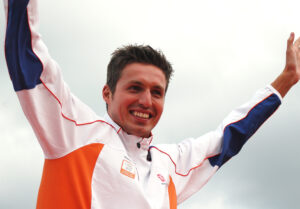
Pieter van den Hoogenband (courtesey of McSmit)
Sydney also delivered one of swimming’s greatest upsets. Australia’s Susie O’Neill, nicknamed “Madame Butterfly,” was expected to dominate the women’s 200 butterfly. Instead, Misty Hyman of the U.S. stormed home in 2:05.88, outlasting the heavy home favorite. O’Neill still came away with gold at the games, winning the 200 freestyle. O’Neill has since moved into a career in broadcasting and sports leadership. Hyman turned her underdog triumph into a career as a coach with a stint at Arizona State and the founder and president of MistyFly, LLC.
No retrospective is complete without Michael Phelps. At 15, he was the youngest American male swimmer at an Olympics in 68 years, finishing fifth in the 200 butterfly final. Months later, the high schooler notched his first world record in the event, catapulting his lengthy and illustrious career into orbit.
What transpired was unprecedented dominance: 28 Olympic medals, 23 of them gold, highlighted by the immaculate eight-for-eight gold haul in Beijing 2008. Today, Phelps is recognized as one of the most noteworthy athletes in history. He is also deeply involved in mental health and water safety through the Michael Phelps Foundation, while also speaking out on athlete welfare and USA Swimming governance.
Phelps was not the only teenager to make history in Sydney, at just 15, Leisel Jones won silver in the women’s 100 breaststroke, beginning a career that would yield nine Olympic medals. Romania’s Diana Mocanu, just 16, swept the women’s 100 and 200 backstroke, delivering her country’s first Olympic swimming golds.
Inge de Bruijn was the undisputed sprint queen of Sydney, delivering one of the most dominant performances of the Games. The Dutch star won three individual gold medals; the 50 freestyle, 100 freestyle, and 100 butterfly, setting world records in each event, plus a silver in the 4×100 freestyle relay. Her explosive speed and ability to rise in big moments made her one of the breakout female swimmers of the Olympics.
Dara Torres, at 33, after seven years removed from competition, returned to Sydney to win a pair of relay golds and a trio of individual bronze medals before returning in 2008 at age 41 to cement her status as one of the most reliable American sprinters in history. Today, she spearheads the Boston College program as the head coach of both the men’s and women’s programs.
But one of the most recognizable Olympic moments in history came at the hands of Eric “the Eel” Moussambani, from Equatorial Guinea, who finished his men’s 100 freestyle heat to thunderous cheers. Having never swum in an Olympic-sized pool, Moussambani would win his heat after the other two competitors were disqualified for false starts. The swim is still regarded as a pure showing of Olympic spirit to this day. Moussambani would go on to become the head coach of the Equatorial Guinea national team.
Sydney 2000 was a turning point for swimming 25 years ago. Thorpe fired up a nation, Hyman showed us how preparation can lead to glory and beat the odds, Phelps made his first stride towards immortality, and Moussambani brought the world together in triumph. It was not just the records, and medals, but also the stories that last a generation.

No mention of Yana Kochkova sweeping the IMs – 200 in OR and ER and the 400 in WR?
Or Terence Parkin, who is deaf, coming 2nd int he 200 breast with an African record?
While the Sydney Olympics were a grand success for Ian Thorpe, the years afterward have been less than kind. Struggles with alcohol and depression; the death of Ryan Channing (a former partner), etc. remind us all that life’s pain and difficulties aren’t solved with Olympic glory, but, indeed, may be exacerbated by its aftermath.
You mentioned teenage Michael Phelps, and teenage Leisel Jones, but not teenage Megan Quann who won gold? Weird
HTH. Seems like this is the page some of yous were looking for:
https://en.wikipedia.org/wiki/Swimming_at_the_2000_Summer_Olympics
The significance of Ian Thorpe’s achievements becomes only more apparent as the years go by. Check out the other winning swims from Sydney.
Women’s 400 was won with a 4:05.8
Men’s 400 IM was 4:11.76 in a new world record.
Men’s 200 back was 1:56.7.
Great for their day, but advancements in training and swimsuit technology have moved the sport far beyond.
Then there’s a 17 year old kid who by the standards of 2025 had suboptimal underwaters and streamlines, going a time that would have won the world championships this year by 1.5 seconds. Then an hour later he anchors the 4×100 free relay to gold…
Despite the aforementioned advancements in the sport, his… Read more »
Thorpey true legend
I were always wondering how much greater would he have been had:
1. He didn’t have inner turmoils
and
2. He had a great coach of the calibre of Bohl/Bowman/Talbot/Boxall/Reese etc
Yeah the biggest what-if in the sport for me is easily that.
If he had someone like Dennis Cotterell maybe. Doug Frost did mold Thorpe into the machine that he was at a young age, but he also antagonized him and didn’t give him the support he needed which made Thorpe lose his trust in him.
Imagine if Bowman was going to the press in 2004 bragging about Michael being able to win 9 gold medals someday. That’s literally what Frost was doing lol.
There was also the internal struggles from depression, being closeted, and wanting to get away from the media spotlight. He became a superstar in Australia at 15 and everyone wanted a piece of him,… Read more »
The GREATEST freestyler of all time.
And it’s not even close…
His 400 Free has to be one of greatest swim of all time.
Those were the days, pumped to see how LA 2028 is
you also had some great distance swims as well. Munz coming from fourth to second in the last 100. The 1500 for men saw an american on the stand in some time, since 84(?).
I got to swim in that pool and even without the olympics, it was a great place. Loved the crowd!!
no mention of Hackett? That man is a legend
Susie ONeill did not ‘avenge her loss’- the 200m freestyle was before her 200m butterfly loss….
Eric “the Eel” Moussambani moment was Olympic is all about.
Pure Olympics spirit.
I dare say that is not what olympics should be about. Imagine the men and women who dont get to compete in the games (specially the americans) who could even vye for a medal…and then you see Eric swimming 100 free in 1 minute and 50 seconds. Universality should have minimum quality. Altough I consider he had heart in finish the race, I feel for every better swimmer that stayed at home because of universality quotas