2026 NCAA Division I Women’s Swimming and Diving Championships
- Wednesday, March 18 – Saturday, March 21, 2026
- McAuley Aquatic Center, Atlanta, GA
- Defending Champions: Virginia (5x)
- Championship Central
- Preview Index
- Psych Sheet
- Live Stream
- Live Results
- Live Recaps
Through the first two days of racing at the 2026 women’s NCAA championships we have seen a trio of titles for Virginia, but in terms of the fastest combined takeover time it is Minnesota who top the standings.
In the 200 free relay they posted a combined add-up of 0.14 seconds, with Morgan Thomas (0.08) and Rachel Conley (0.07) both under a tenth of a second on their exchanges before Ava Yablonski (-0.01*) pushed her takeover almost to the edge.
*Relay exchanges down to -0.03 are allowed, as the timing equipment has a tolerance of 0.03 seconds.
Minnesota’s performance this year ranks them joint-fifth over the last decade at NCAAs. They are tied with a pair of 400 medley relay teams – Louisville’s from 2018 and Texas’ from 2021, both of which finished in the top four in their respective races.
There have been a total of 53 teams to have a combined relay add up of 0.30 seconds or better since 2016 – averaging a tenth of a second per swimmer. The fastest of those came from Florida’s 400 medley relay team in 2024, with a combined add up of just 0.09 seconds – an average of 0.03 seconds per swimmer.
Four teams had two swimmers at 0.00 or better – Duke’s 2023 400 medley team, UNC’s 2018 400 medley team, UNC’s 2025 400 medley team, and the Texas A&M team from 2022 in – yep, you guessed it – the 400 medley relay.
Relay Teams With A Combined Takeover Time Of 0.30 Seconds Or Better, 2016-2026 NCAAS
| Rank | School | Time | Year | Relay | Round | Swimmer 2 | Swimmer 3 | Swimmer 4 | Position |
| 1 | Florida | 0.09 | 2024 | 400 medley | heat | 0.09 | -0.01 | 0.01 | 4 |
| 2 | VT | 0.10 | 2023 | 200 free | heat | 0.07 | 0.03 | 0.00 | 11 |
| 3 | Louisville | 0.11 | 2018 | 200 medley | final | 0.03 | 0.03 | 0.05 | 5 |
| 4 | FSU | 0.13 | 2023 | 200 medley | heat | 0.03 | 0.10 | 0.00 | 17 |
| 5 | Louisville | 0.14 | 2018 | 400 medley | final | 0.03 | 0.00 | 0.11 | 4 |
| 5 | Texas | 0.14 | 2021 | 400 medley | heat | 0.13 | 0.02 | -0.01 | 3 |
| 5 | Minnesota | 0.14 | 2026 | 200 free | heat | 0.08 | 0.07 | -0.01 | 21 |
| 8 | NC State | 0.15 | 2025 | 200 medley | heat | 0.07 | 0.00 | 0.08 | 6 |
| 9 | Arizona | 0.16 | 2022 | 200 medley | heat | -0.01 | 0.13 | 0.04 | 16 |
| 9 | Duke | 0.16 | 2023 | 400 medley | heat | -0.03 | 0.21 | -0.02 | 19 |
| 9 | FSU | 0.16 | 2025 | 400 medley | heat | 0.04 | 0.10 | 0.01 | 16 |
| 12 | FSU | 0.17 | 2018 | 200 free | heat | -0.03 | 0.16 | 0.04 | 23 |
| 12 | UNC | 0.17 | 2023 | 400 medley | heat | 0.06 | 0.03 | 0.08 | 9 |
| 12 | Texas A&M | 0.17 | 2026 | 200 free | heat | 0.13 | 0.00 | 0.04 | 12 |
| 15 | UNC | 0.18 | 2018 | 400 medley | heat | -0.03 | 0.00 | 0.21 | 22 |
| 16 | Texas A&M | 0.19 | 2026 | 200 medley | heat | 0.05 | 0.16 | -0.02 | 19 |
| 17 | Tennessee | 0.20 | 2023 | 200 medley | heat | 0.03 | 0.12 | 0.05 | 11 |
| 18 | Kentucky | 0.21 | 2016 | 400 medley | heat | 0.13 | 0.00 | 0.08 | 19 |
| 18 | Michigan | 0.21 | 2017 | 400 medley | final | 0.00 | -0.02 | 0.23 | 11 |
| 18 | Denver | 0.21 | 2017 | 400 medley | heat | 0.02 | 0.19 | 0.02 | 26 |
| 18 | Notre Dame | 0.21 | 2019 | 400 medley | heat | -0.01 | 0.12 | 0.10 | 25 |
| 22 | Alabama | 0.22 | 2023 | 400 medley | heat | 0.09 | -0.01 | 0.14 | 13 |
| 22 | Auburn | 0.22 | 2023 | 400 medley | heat | 0.00 | 0.20 | 0.02 | 14 |
| 22 | Arizona | 0.22 | 2025 | 200 free | heat | 0.06 | 0.05 | 0.11 | 10 |
| 25 | Duke | 0.23 | 2016 | 200 free | heat | 0.02 | 0.04 | 0.17 | 21 |
| 25 | UNC | 0.23 | 2025 | 400 medley | heat | -0.01 | 0.24 | 0.00 | 22 |
| 25 | Michigan | 0.23 | 2026 | 200 medley | heat | 0.03 | 0.12 | 0.08 | 6 |
| 28 | FSU | 0.24 | 2017 | 200 medley | heat | 0.14 | 0.07 | 0.03 | 10 |
| 28 | Duke | 0.24 | 2017 | 200 medley | heat | 0.05 | 0.05 | 0.14 | 19 |
| 30 | Stanford | 0.25 | 2021 | 400 medley | heat | 0.08 | 0.08 | 0.09 | 8 |
| 30 | Texas A&M | 0.25 | 2022 | 400 medley | heat | 0.25 | 0.00 | 0.00 | 17 |
| 32 | Michigan | 0.26 | 2017 | 200 medley | heat | 0.15 | 0.07 | 0.04 | 21 |
| 33 | USC | 0.28 | 2017 | 200 free | final | 0.09 | 0.10 | 0.09 | 11 |
| 33 | Texas A&M | 0.28 | 2017 | 200 medley | final | 0.04 | 0.04 | 0.20 | 2 |
| 33 | Duke | 0.28 | 2019 | 400 free | heat | -0.03 | 0.17 | 0.14 | 12 |
| 33 | Michigan | 0.28 | 2021 | 800 free | heat | 0.17 | 0.02 | 0.09 | 10 |
| 33 | UCLA | 0.28 | 2023 | 400 medley | heat | 0.12 | 0.10 | 0.06 | 21 |
| 33 | Wisconsin | 0.28 | 2026 | 200 medley | heat | 0.07 | 0.14 | 0.07 | 12 |
| 33 | Auburn | 0.28 | 2022 | 400 free | heat | 0.02 | 0.14 | 0.12 | 21 |
| 40 | Tennessee | 0.29 | 2017 | 200 medley | heat | 0.15 | 0.06 | 0.08 | 11 |
| 40 | Wisconsin | 0.29 | 2017 | 200 medley | heat | 0.10 | 0.18 | 0.01 | 13 |
| 40 | Duke | 0.29 | 2019 | 200 medley | final | 0.12 | 0.11 | 0.06 | 13 |
| 40 | Northwestern | 0.29 | 2022 | 200 free | heat | 0.10 | 0.04 | 0.15 | 17 |
| 40 | Texas A&M | 0.29 | 2022 | 200 free | heat | 0.27 | 0.02 | 0.00 | 19 |
| 40 | Wisconsin | 0.29 | 2025 | 200 free | heat | 0.05 | 0.16 | 0.08 | 13 |
| 46 | Wisconsin | 0.30 | 2017 | 200 medley | final | 0.13 | 0.07 | 0.10 | 12 |
| 46 | Northwestern | 0.30 | 2022 | 400 free | heat | 0.03 | 0.04 | 0.23 | 20 |
| 46 | Missouri | 0.30 | 2023 | 200 medley | heat | 0.19 | 0.04 | 0.07 | 20 |
| 46 | Stanford | 0.30 | 2025 | 200 medley | heat | 0.00 | 0.23 | 0.07 | 2 |
| 46 | Cal | 0.30 | 2025 | 200 medley | heat | 0.00 | 0.09 | 0.21 | 4 |
| 46 | Indiana | 0.30 | 2025 | 200 medley | heat | 0.01 | 0.22 | 0.07 | 10 |
| 46 | Missouri | 0.30 | 2026 | 200 medley | heat | -0.01 | 0.21 | 0.10 | 20 |
| 46 | Missouri | 0.30 | 2026 | 200 free | heat | 0.11 | 0.08 | 0.11 | 21 |
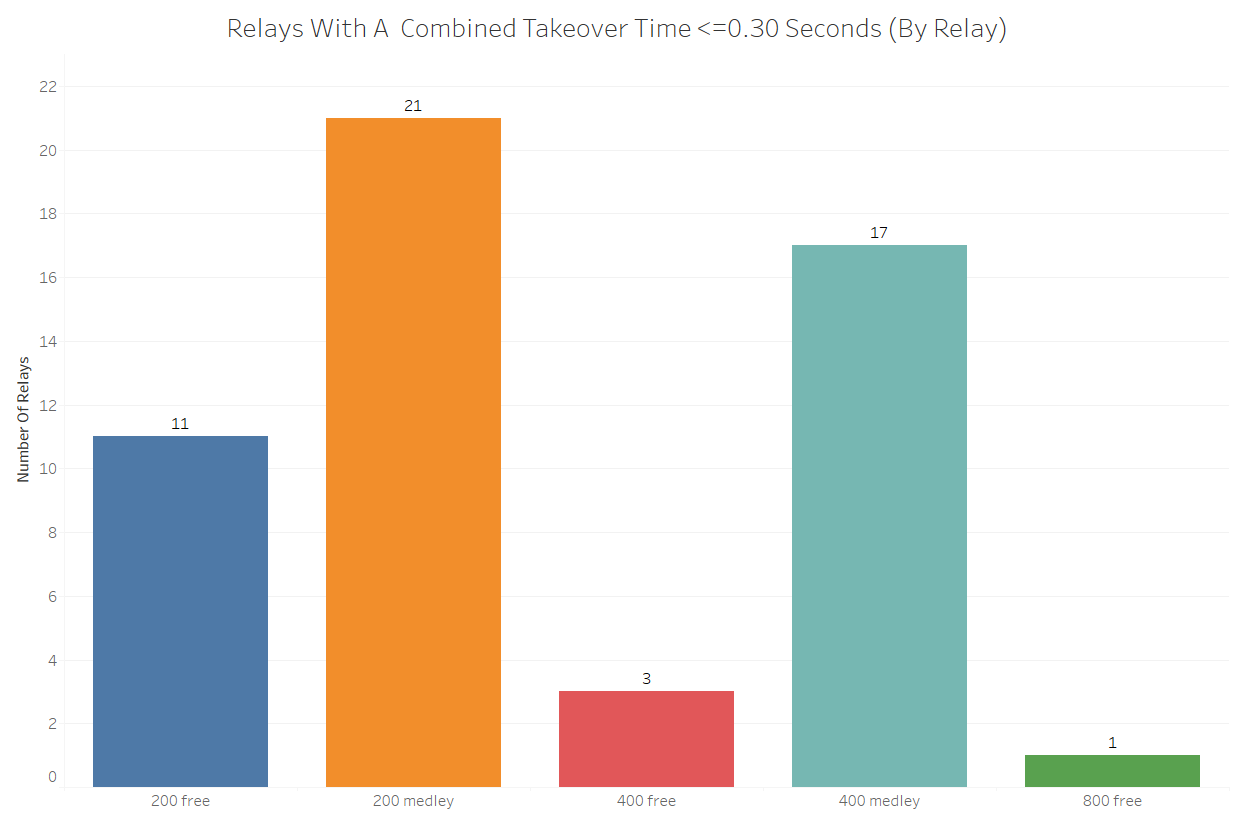
The two medley relays lead the way, with 21 teams in the 200 medley under this barrier and 17 in the 400 medley. Just one 800 free relay team has done so – Michigan in 2021 – and the 400 free relay’s position at the end of the meet could play a part in only three teams in ten years pushing the takeovers close.
Relays With A Combined Takeover Time <= 0.30 seconds (By Relay)
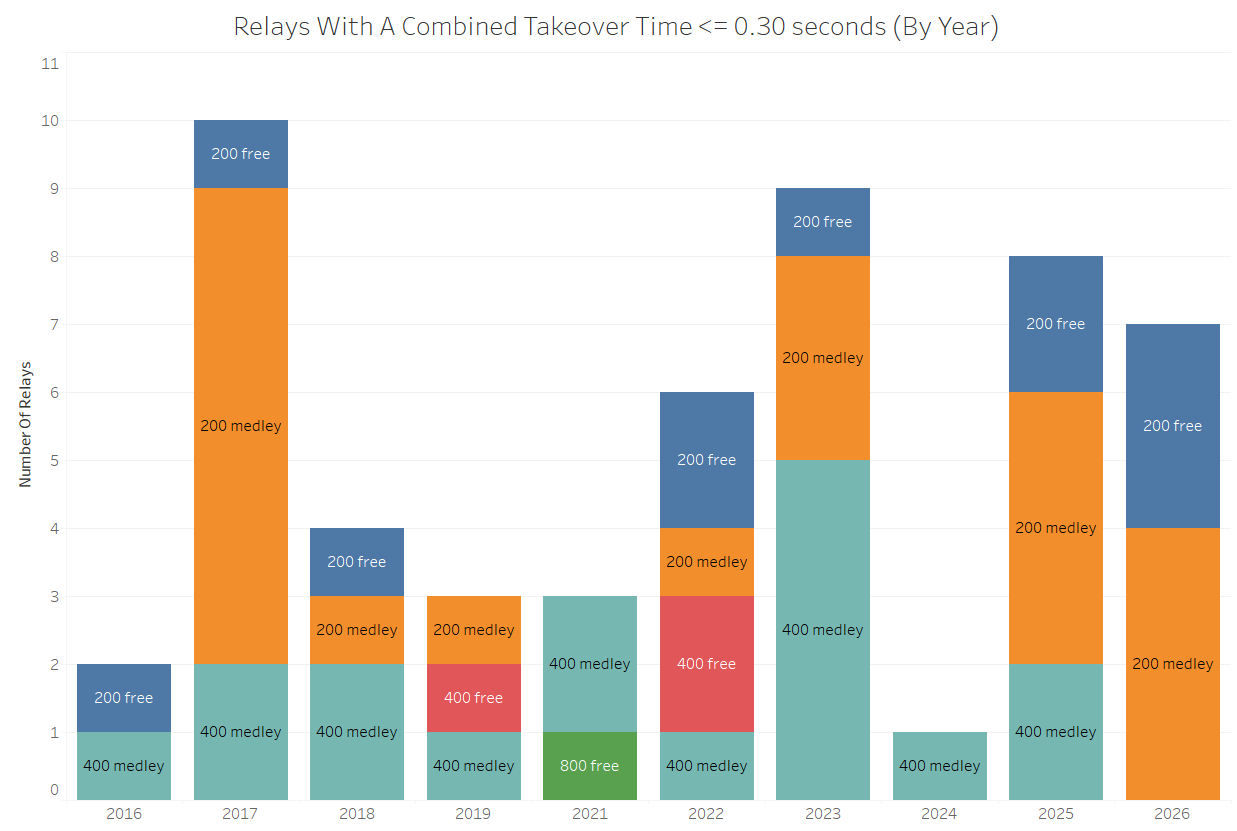
This year is on track to have the most teams to break the 0.30 second barrier since 2017. Seven teams have done so with two relays to go, one fewer than the eight that did so in 2017 but one more than at this point in 2025.
Relays With A Combined Takeover Time <= 0.30 seconds (By Year)
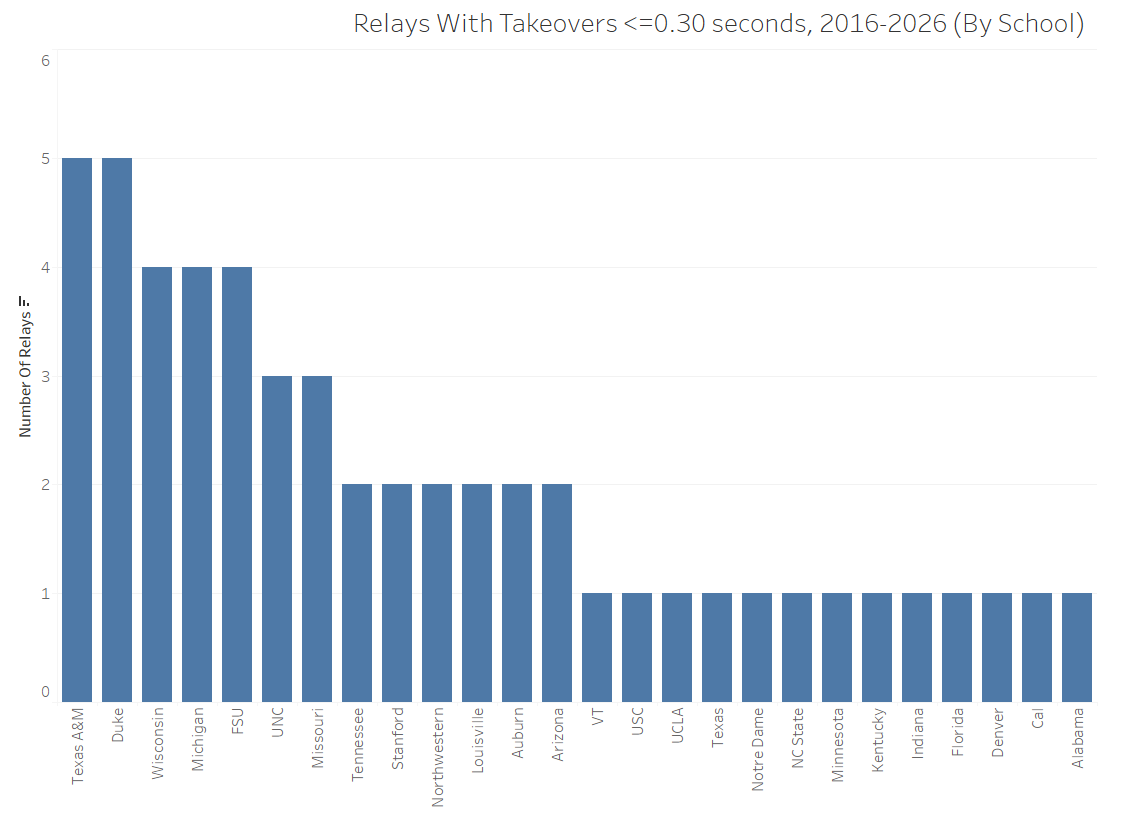
There have been seven schools to have dipped under the 0.30 mark twice at one meet. Missouri and Texas A&M have both done so in 2026, and have the opportunity to become the first team to do so in three relays in the last decade if they manage it in either the 400 medley or 400 free.
Kaitlyn Owens has been on all four of the Texas A&M relays, but has always been on the leadoff leg.
- Michigan, 2017 – 200 medley, 400 medley
- Wisconsin, 2017 – 200 medley (heat), 200 medley (final)
- Louisville, 2018 – 200 medley, 400 medley
- Duke, 2019 – 200 medley, 400 free
- Northwestern, 2022 – 200 free, 400 free
- Missouri, 2026 – 200 medley, 200 free
- Texas A&M
- 2022 – 400 medley, 200 free
- 2026 – 200 medley, 200 free
Relays With A Combined Takeover Time <= 0.30 seconds (By School)

Well…at least they are top at SOMETHING!
That 8th place finish at Men’s Big Tens was WOW! Lowest finish since BEFORE the Jean Freeman Pool was built.
On the Women’s side after 12 straight years of runner-up finishes followed by 4 years of 3rd place finishes…they are now 6th!
So top exchange for the relay is truly a bright spot after being 6th on the Women’s side and 8th on the Men’s!
ski-u-mah!
https://www.facebook.com/61572202042513/posts/122159120132740068/?app=fbl
Are men’s stats similar?
I will say UVA’s Curtis won the takeoff crown. She went 20.55 split with a .40 takeoff. Not a fan of trying to see how close you can make it…risk/reward isn’t worth it to me! (ie Cal and Louisville is costing them big time)