Summer McIntosh has the women’s 200 fly world record in her sights.
That is not just a claim based on the proximity of her best time to Liu Zige’s 17-year-old mark of 2:01.81. McIntosh stated in an interview after her swim at Canadian Trials last year that this is the record she wants above all – one which was long considered untouchable, and in the event her mom, Jill, specialized in during her swimming career.
McIntosh has taken around one second off her 200 fly time in each of the last three years, helped by a progressively stronger back end. A big reason for this? The continued improvement she has shown in her underwater work since winning her first world title.
The Canadian star has had to come a long way since racing the event for the first time on the international stage at the 2022 World Championships. Underwater work was not an area of strength for her there, perhaps unsurprisingly considering she was still just 15.
Regan Smith, who swam next to her in that final in Budapest, has been the queen of underwaters on the 200 fly for a while now. In the Paris Olympic final, Smith swam more than a quarter of the race underwater (52.9m), a full 16 meters further than McIntosh did. The difference in their average speed underwater was negligible, but what that showed was how much better Smith was at maintaining her speed underwater compared to McIntosh.
Why Is That?
Let’s break the underwater phase down into two areas: the launch off the wall and the fly kick section. We’ll take the boundary between the two at four-meter marks. Before this point, most world-class 200 butterfly swimmers are presumably almost identical, so we’ll assume Smith and McIntosh cover this distance in the same time. Including the rotation at the turn, we’ll say it takes them two seconds from touching the wall to being at the end of the first phase.
For the rest of this section, we’ll take the third turn in Paris as an example. The overall data for that turn (collected by the French Swimming Federation) looks like this:
| Swimmer | Distance (m) | Time (s) | Velocity (m/s) |
| Regan Smith | 12.14 | 7.26 | 1.67 |
| Summer McIntosh | 7.81 | 4.64 | 1.68 |
Now, take away that first phase:
| Swimmer | Distance (m) | Time (s) | Velocity (m/s) |
| Regan Smith | 8.14 | 5.26 | 1.55 |
| Summer McIntosh | 3.81 | 2.64 | 1.44 |
The difference is notable.
Marginal Gains?
McIntosh, though, has been steadily improving the underwater phase on her 200 fly over the last four years. She relied almost exclusively on her speed over the water to win her first world title in 2022, barely passing the 5m mark on her final two turns, but swam nearly 20% of the 2025 World final underwater. That section of her race was also at a faster pace last summer than in 2022, despite the huge increase in distance.
She will swim just one major international meet this summer, the Pan Pacific Championships, having announced back in August that she would forgo the opportunity to defend the pair of Commonwealth titles she won in the 200 and 400 IM back in 2022. Given that she swam the fourth-fastest time in history in the 200 fly at the U.S. Open in December, she looks to be on track to take another run at the world record this season.
How much of an underwater improvement would that require? Her Canadian Record of 2:01.99 is just 0.18 seconds off Liu Zige’s super-suited mark, so even without any increase in speed on top of the water, the underwater improvement she needs is minimal. Certainly, if McIntosh matched the progress she had last season without losing anything over the water, she would crack the 17-year-old standard.
We looked at the evolution of her splitting of the race last summer, and will reuse some of the data here. We’ll tease out just how much of that evolution is due to differences in her underwater phase, and split out the underwater improvements from the swim speed improvements.
World and Olympic Finals: Underwater and Swim Speed Data
Data for the Paris Olympic final was collected by the French Swimming Federation and is both detailed and accurate. All other data was collected from race videos; times recorded multiple times with a stopwatch, cleaned, and then averaged, and distance estimated manually based on lane markings.
The data (time and distance) was recorded to one decimal place (1dp). The overall time was rounded to 1dp to be consistent, as was the FFN-collected data.
| Meet | Turn | Underwater Distance (m) | Underwater Time (s) | Underwater Velocity (m/s) | Swim Distance (m) | Swim Time (s) | Swim Velocity (m/s) | Overall Distance (m) | Overall Time (s) | Overall Velocity (m/s) |
| 2022 Worlds | 1 | 9.5 | 4.3 | 2.21 | 40.5 | 24 | 1.69 | 50 | 28.3 | 1.77 |
| 2 | 5.8 | 3.2 | 1.81 | 44.2 | 28.6 | 1.55 | 50 | 31.8 | 1.57 | |
| 3 | 5.1 | 3.1 | 1.65 | 44.9 | 29.4 | 1.53 | 50 | 32.5 | 1.54 | |
| 4 | 5.2 | 3.2 | 1.63 | 44.8 | 29.4 | 1.52 | 50 | 32.6 | 1.53 | |
| 2023 Worlds | 1 | 11.4 | 5 | 2.28 | 38.6 | 22.7 | 1.7 | 50 | 27.7 | 1.81 |
| 2 | 7.3 | 4.6 | 1.59 | 42.7 | 26.6 | 1.61 | 50 | 31.2 | 1.6 | |
| 3 | 7.2 | 4.7 | 1.53 | 42.8 | 27.8 | 1.54 | 50 | 32.5 | 1.54 | |
| 4 | 6.6 | 4.2 | 1.57 | 43.4 | 28.4 | 1.53 | 50 | 32.6 | 1.53 | |
| 2024 Olympics | 1 | 12.8 | 4.7 | 2.72 | 37.2 | 22.7 | 1.64 | 50 | 27.4 | 1.82 |
| 2 | 8.1 | 4.7 | 1.72 | 41.9 | 26.9 | 1.56 | 50 | 31.6 | 1.58 | |
| 3 | 7.8 | 4.6 | 1.7 | 42.2 | 27.1 | 1.56 | 50 | 31.7 | 1.58 | |
| 4 | 8.2 | 4.9 | 1.67 | 41.8 | 27.4 | 1.53 | 50 | 32.3 | 1.55 | |
| 2025 Worlds | 1 | 12.7 | 4.9 | 2.59 | 37.3 | 22.3 | 1.67 | 50 | 27.2 | 1.84 |
| 2 | 8.8 | 5 | 1.76 | 41.2 | 26.2 | 1.57 | 50 | 31.2 | 1.6 | |
| 3 | 7.4 | 4.4 | 1.7 | 42.6 | 27.2 | 1.57 | 50 | 31.6 | 1.58 | |
| 4 | 8.9 | 5.1 | 1.75 | 41.1 | 26.9 | 1.53 | 50 | 32 | 1.56 |
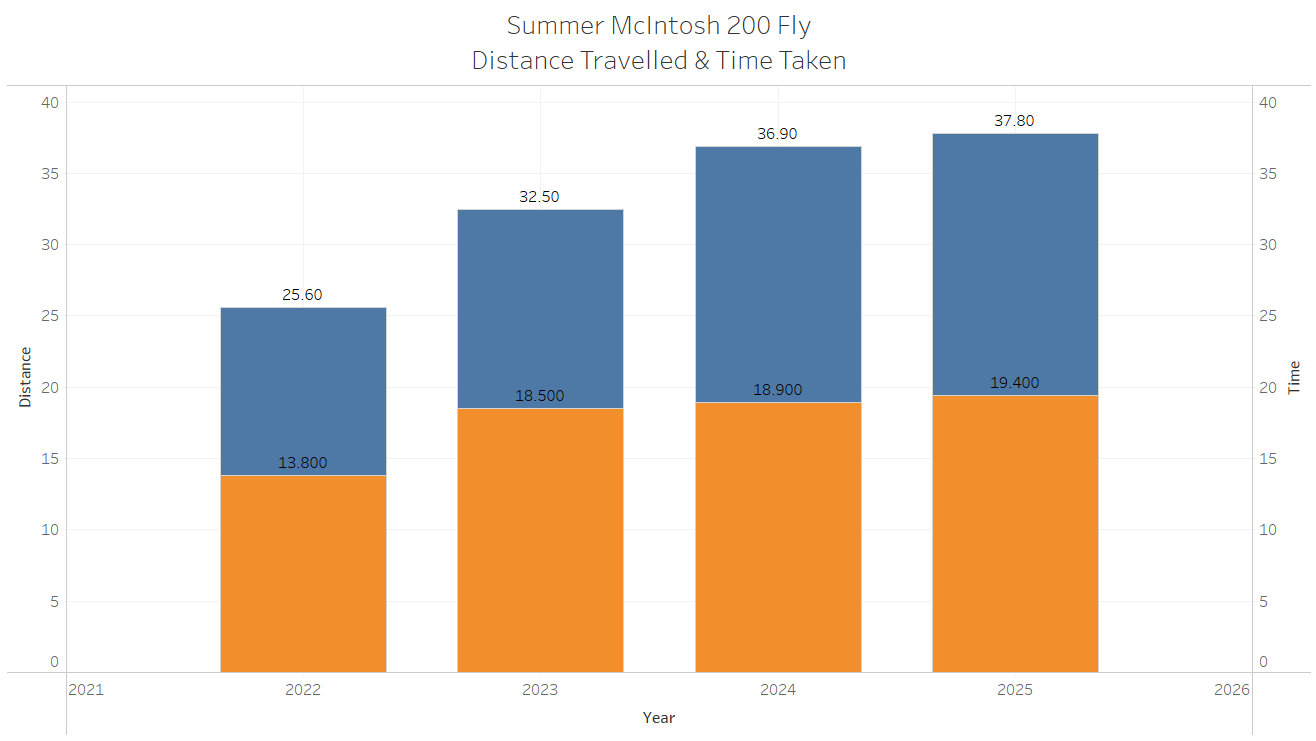
One trend becomes immediately clear. McIntosh had a huge step up after her first world title in 2022, both in terms of time spent underwater and distance travelled.
That didn’t necessarily translate to a higher underwater velocity, for the same reason we mentioned earlier with regards to Regan Smith.
McIntosh spent nearly five seconds longer underwater over the course of the race in 2023, and has increased that time slightly in each of the past two summers. Along with that has come a huge increase in the distance travelled – nearly 50% further in 2025 than in 2022.
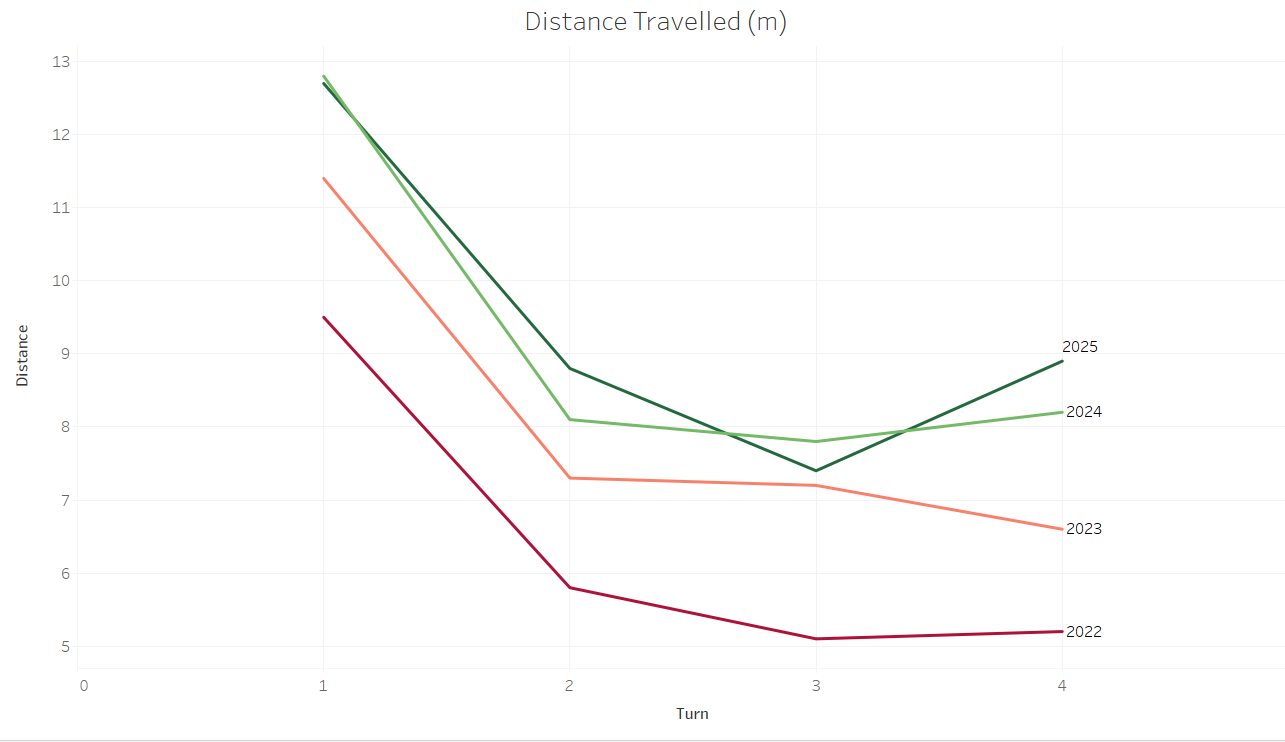
Breaking the distance down by turn, we can see that the increases have been relatively egalitarian. There is a noticeable trend in both 2024 and 2025, however, her final 50 sees a longer underwater than the penultimate one.
That was only a slight increase in Paris, but there was a massive difference of 1.5 meters in Singapore. Her underwater velocity on the final underwater last year was also higher than on her third one (1.75 m/s vs 1.68 m/s), contrary to her 2024 swim (1.70 m/s vs 1.67 m/s).
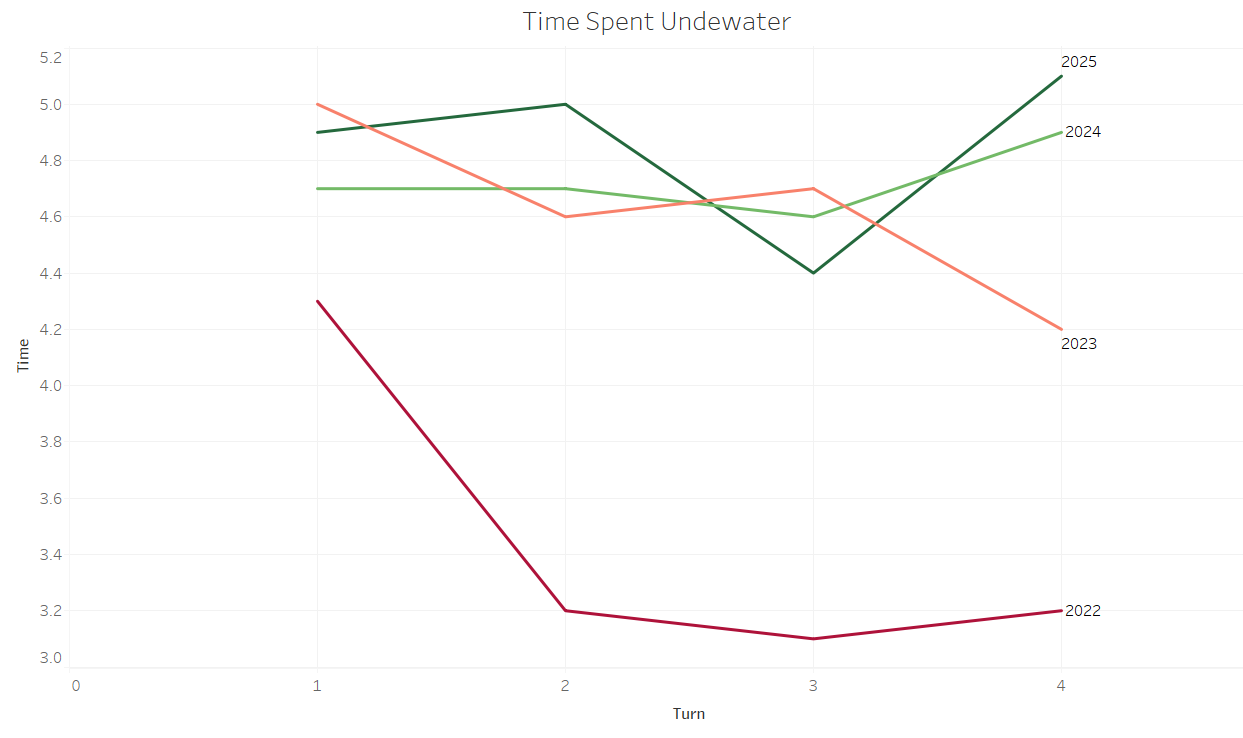
The time spent underwater has also varied somewhat, despite her last three summer swims having relatively similar cumulative times. That final turn seems a clear point of focus – after spending half a second less there than on the preceding turn in 2023, she spent 0.3 seconds longer underwater in 2024 and 0.7 seconds longer underwater in 2025.
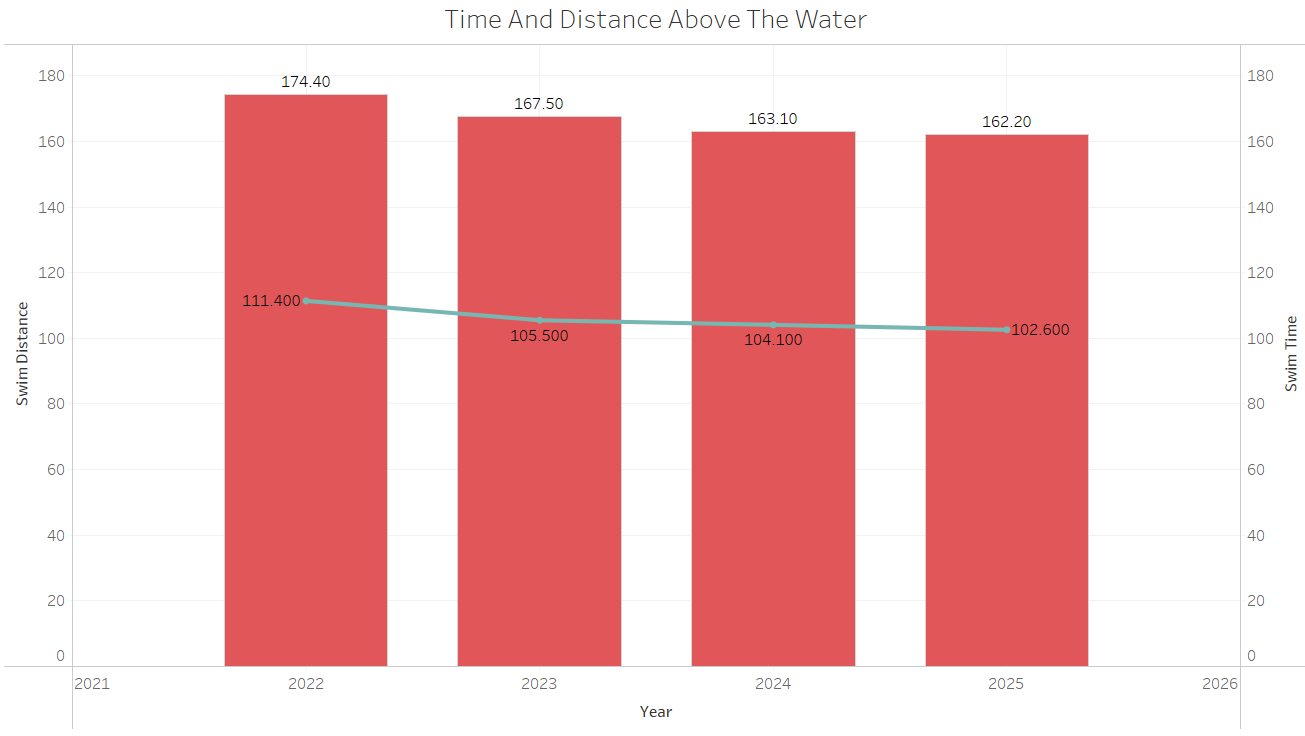
What more time underwater inevitably means is less time spent on the surface. Her swim distance and swim time have both dropped, although her swim speed hasn’t necessarily been on a continuous upward trend.
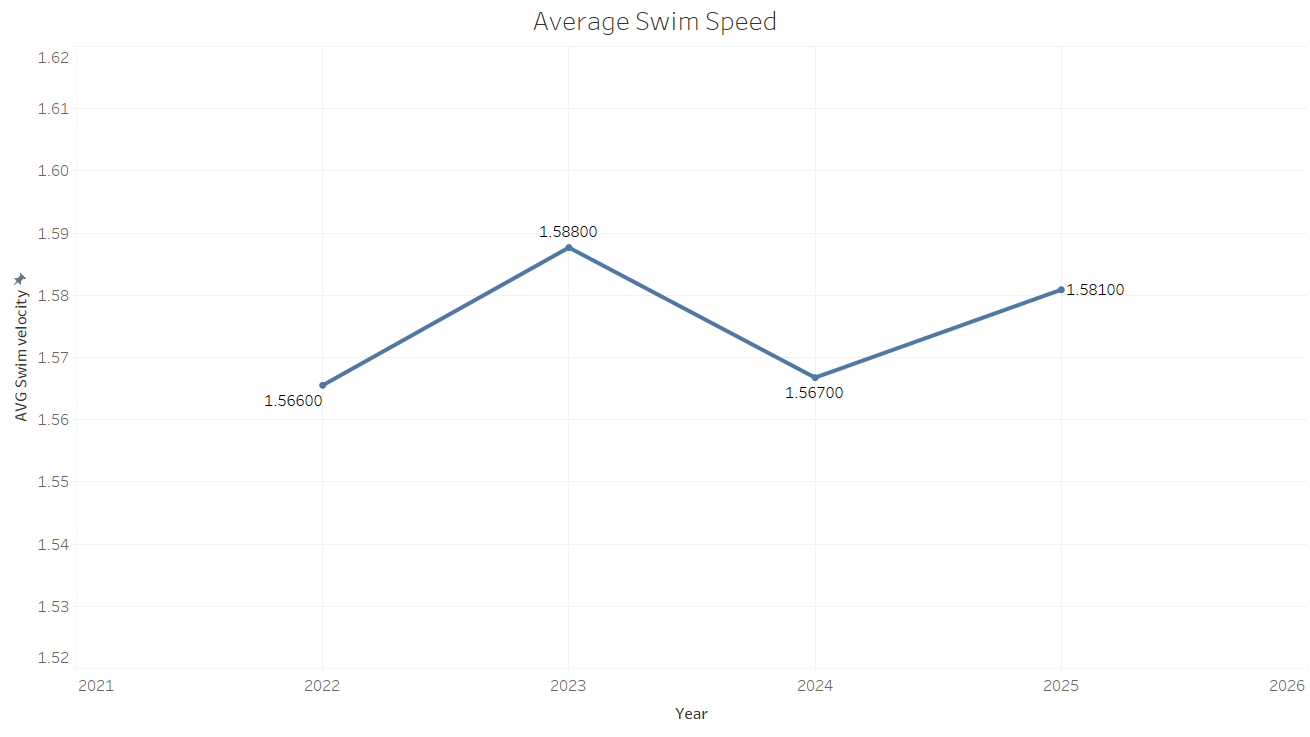 The year of her fastest swim speed actually appears to be 2023, when she swam 2:04.06 to defend her world title. She swam 167.5 meters on top of the water that year in a combined 105.5 seconds for an average swim speed of 1.588 m/s, slightly ahead of her 2025 swim speed of 1.581 m/s.
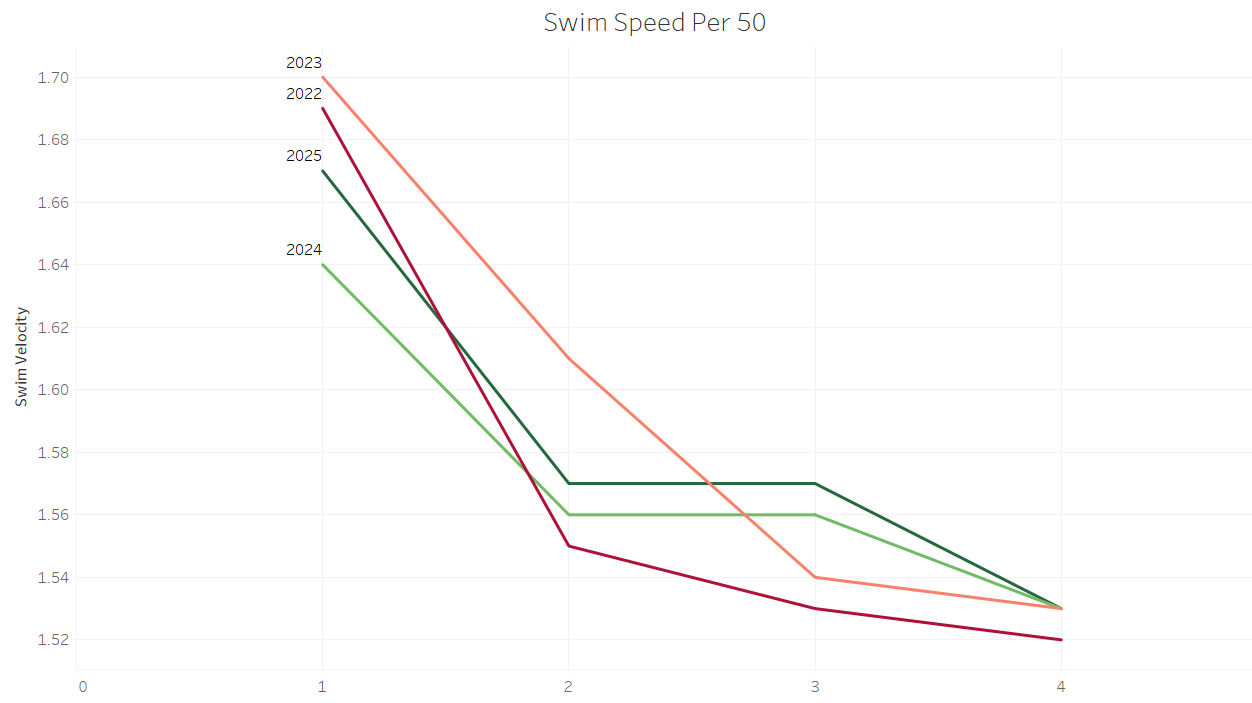
This is not the be-all and end-all – McIntosh was over two seconds faster in 2025 than in 2023, thanks to an additional 5.3 meters spent underwater for only an additional 0.9 seconds. Her improved underwaters likely helped her to manage that swim speed better as well – her velocity dropped precipitously through the four 50s in 2023, but was relatively stable after the first 50 in both 2024 and 2025.
It will not take much for McIntosh to find the two-tenths of a second she is missing to finally crack the 200 fly world record. Adding another half a meter on her third underwater to bring it back to her 2024 level, while maintaining her 2025 swim speed, would give her six-hundredths – one-third of what she needs.
It may be small improvements like this, what British Cycling’s Dave Brailsford calls ‘marginal gains’, that get her over the line. Training alongside Regan Smith would certainly be a help with that – racing alongside her in Irvine this summer could well see McIntosh get there.

Data is good stuff…she will get faster by just being in the most competitive practice squad in history!
How much ‘tech’ is required to upgrade touch pads to measure “time at the wall” and not just 1st touch?
The number that stands out to be is the 7.4 from third wall at 2025 world championships.
There was a Monty Python skit titled, “Spot the Looney.” That 7.4 is the looney. McIntosh is typically the most impatient on the third wall, surfacing earlier than 2 or 4. But regardless of her underwater level at the time the gap is within .6 or .7.
Not with that 7.4 looney. It was a double betrayal from the 8.8 and 8.9 surroundings.
McIntosh blamed the near miss to the world record on a late extra breath. It looks like the explanation came in the same area of the pool but a minute earlier while heading in the opposite direction.
Underwater is a kind of cheating
Great analysis – the kind of thing I imagine most top-tier coaches are doing with their swimmers.
Question: how did you collect the data? Are you just watching publicly-available race videos on youtube, slowed down, and estimating distances based on the lane lines?
Looking forward to Summer breaking Kornelia Ender’s record
Do you mean Otto (6 golds in one Olympics, 4 individual)? I don’t think Ender has any significant records in terms of performance
Are you referring to the East German program that set ridiculous records and it turned out years later to from PEDs?
Yes… Ender and Otto are both from that team. I just thought you were referring to the wrong one.
Great start for the analysis, but why make the assumption? You’re measuring to the centimeter off the wall and the 1/100s, it would be interesting to actually know the touch to turn to push times and eliminate any guesswork.
It is far harder to time to the end of the push phase – unlike the breakout, there is no clear end to the phase to base it off. Additionally it would be a nightmare to measure. As the breakout takes place at the surface of the water, the phase space ends up as a 2d plane, but for the relatively arbitrary ‘4m from the wall’ you’re into 3d vectors to determine that 4m, and determining the depth of a swimmer accurately from the camera angles we get in a race video is nigh-on impossible.
It would be more illuminating to be swimmer specific, but that isn’t really possible with what we were working with. It was more an… Read more »
I see.. this was an average.. Distance: 12.14m, time: 7.26s .. got it.
OK, I’m sure it’s an incredibly difficult task all around. The eye test says Summer’s turns are also slower than Regan’s, in addition to Regan’s UW superiority. I wonder what would skew if you took touch time to breakout time. My suspicion is time increase ratio to overall time is higher for Summer than Regan, maybe adjusting your assumption to only account for probably 1s for the first 4m.
Anyway, great work, real data is always nice after so many years of, well it looks like her UW’s are faster.
The 2024 data was collected by the French Swimming Federation (https://www.ffnatation.fr/sites/default/files/2024-08/Livret%20analyses%20finales%20JO%20Paris%202024.pdf) – they did go to hundredths on both time and distance, and should be more accurate than the data from the other finals.
It may well be closer to 1.5 seconds for the ‘touch to 4m’ phase, but the difference would then end up much larger – 1.52 m/s to 1.21 m/s).
The dream would be for every major swim meet to publish the data they did for the Paris Olympics. Unfortunately I think that was more of an aberration than the start of a trend.
This data is great. Love seeing the underwater speed with numbers and not just the clock. Thank you for this!