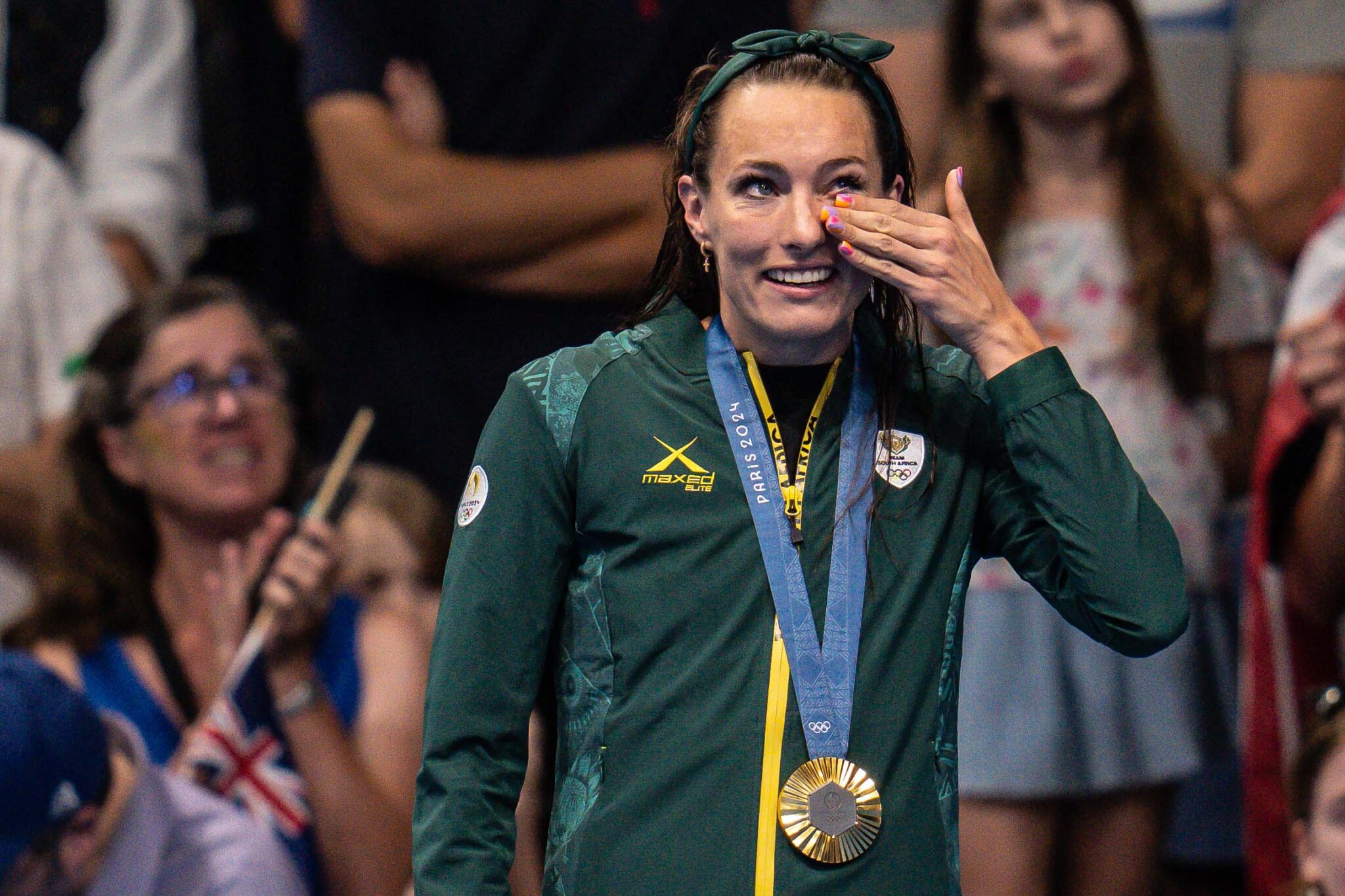
This article originally appeared in the 2025 World Championship Preview issue of the SwimSwam Magazine. Subscribe here.
For many athletes, the Olympic Games represent the pinnacle of their careers, a moment that defines their legacy. But what happens after the spotlight fades? For South African swimming champion Tatjana Smith, navigating life beyond the pool has been a journey of self-discovery, reflection, and resilience.
Fresh off the Paris Olympics, Smith acknowledges the fleeting nature of public attention that comes with major sporting events. “After the Olympics, especially in sports like swimming, there’s only a limited time where the spotlight shines on you. So, it’s about making the most of that period before it fades,” she explains. However, beyond the media engagements and celebrations, she is also contemplating what comes next. “It’s about figuring out what I want to do after swimming—keeping myself busy and exploring new interests. Public speaking, for example, wasn’t something I ever imagined doing, but it’s pushing me out of my comfort zone, and I see that as a good thing.”
Retirement from competitive swimming was both an abrupt decision and a long process for her. She describes the emotional rollercoaster that comes with stepping away from the sport she dedicated her life to. “There are days when I feel strong and others when I struggle. I’ve been lucky to move forward without too much emotional baggage, but I don’t think I fully realize how much time has passed since I was immersed in that world. As national and World Championships approach, I start missing it more.”
Tatjana acknowledges the necessity of allowing herself to grieve the transition. “Swimming was never my identity—it was just something I did. But that doesn’t mean I don’t feel the loss. I still have moments of mourning for that part of my life.”
The Olympic Champion also points out the challenge of processing change when the spotlight remains on her. “After winning gold in Tokyo, my life changed dramatically. It took over a year for the noise around me to quiet down, and only then did I truly begin to process everything. That’s why the four-year gap between the Olympics exists—athletes need time to adapt. But with only three years between Tokyo and Paris, that adjustment period felt even shorter.”
Tatjana’s road to Olympic success was far from easy. Missing the 2016 Rio Games by a fraction of a second fueled her determination for Tokyo. “That disappointment pushed me forward. I was so close to making it that it made me work even harder.”
Tokyo, held under the unique circumstances of the COVID-19 pandemic, brought unexpected advantages. “The lack of a massive crowd worked in my favor. In South Africa, we aren’t used to competing in front of thousands of spectators, so the quieter atmosphere helped me focus.”
Winning gold in the 200m breaststroke and silver in the 100m breaststroke established her as a national hero, earning her the nickname “Golden Girl” back home. But with success came new challenges. “In South Africa, when you win gold, people expect you to do it again. The hardest part is not achieving it once but repeating it.”
The pressure mounted leading up to Paris, where expectations were high. “For three years, I struggled with the mental pressure. Just weeks before the Games, I was battling severe anxiety. The 100m breaststroke, which I usually saw as preparation for my main event, became a blessing when I won gold. It felt like a weight had been lifted off my shoulders.”
Unlike Tokyo, where she celebrated virtually with family, Paris offered a different, more personal experience. “My family was there this time, and that made all the difference. In Tokyo, after winning, you’re swept into media obligations, doping tests, and cooldowns—you barely get to see your loved ones. I could finally share those moments in Paris with them in person.”
However, the pressure remained intense. “In competitive sports, success is often measured only by winning gold. But for me, simply making it to Paris was a victory. The obstacles I overcame just to stand behind the starting block meant more than any medal.”
Between her 100m and 200m events in Paris, Tatjana made a life-changing decision: she would retire.
The choice was not driven by physical limitations but rather a sense of peace.
“I knew it was time. I had achieved what I wanted, and I was ready for the next chapter.”
She also reflected on the financial challenges that played a role in her decision.
“In South Africa, we don’t get paid by our federation, so athletes rely on sponsorships. But sponsorships are often based on performance; if you don’t place at the top, there’s little financial support. Winning bronze, for example, barely covers expenses. I realized that if I continued swimming, it would be purely for financial reasons, and that’s not why I started. I swam because I loved it and wanted to leave on my terms.”
Smith hopes that her story will shed light on the struggles faced by athletes from smaller nations.
“In the swimming world, countries like the U.S. and Australia dominate the conversation. But for athletes from smaller countries, we often feel overlooked. I want young swimmers from Africa to know that they belong on the world stage, even if they don’t have the best facilities. You deserve to be there if you’ve earned your place in the race.”
She also sees her transition as an opportunity to advocate for better support for African athletes. “Swimming isn’t widely recognized in South Africa, and we lack funding. We have a country of over 60 million people, yet only a fraction of them are exposed to competitive swimming. I want to help change that. If we can achieve so much with so little, imagine what we can do with the right resources.”
Tatjana remains deeply grateful for her journey as she steps away from competitive swimming. She embraces the challenges of transitioning to life beyond the sport and continues to inspire others with her story. “I never swam for fame or pressure. I swam because I loved it. And now, as I figure out what comes next, I carry that same passion with me.”
Get More SwimSwam with SwimSwam Magazine

SwimSwam Magazines are big, coming in at nearly a pound per issue. We provide you four massive print issues designed to sit on your coffee table like a piece of artwork. With your yearly subscription, you receive over 600 of pages of swimming’s highest quality print content, and another 5,330+ pages of digital issues, going back to the first issue produced.

Your statements made about Tatjana and myself are false & obviously unsubstantisted. It is a pity that you are under this impression and sharing it on public platforms … also a concern that SwimSwam actually allows this.
The first thing Tatjana did post Tokyo was to start a foundation with the main purpose to assist under priviliged children with a o things, water safety classes. There are many more instances where Tatjana donated money and/or time to assist with initiatives to promote water safety & swimming among kids in need.
The lack of facilities and opportunities for the under priviliged communities are at the top of her frustrations in SA.
Wrt the statement about me rejecting ethnic… Read more »
Tang Qianting is my favorite current Chinese swimmer. But I’m very glad she screwed up the finish of the Paris 100 and Tatjana took full advantage.
After the 200 finish it looked like Tatjana mentioned to Douglass that she was retiring. Douglass’ facial expression indicated she heard something unexpected. It reminded me of Boris Becker telling Pete Sampras that it was his final Wimbledon, as they greeted at the net when Sampras won the final.
Swim fans insist:
the name Schoenemaker
will not be ditched.
Amazing swimmer and always radiant positivity.
I remember how in Tokyo, despite seeding fastest into 100 breast final and strong favourite for gold, she got beaten by Lidia Jacoby, she was still smiling and immediately came over to congratulate Jacoby. That’s when I became a big fan of hers.
This has nothing at throwing shade at her, but no athlete ever deserves anything, they earn their mark and legacy.
She rightfully earned her place by working harder than the average competitor.
I hate that argument that the winner works the hardest. I swam 10 times a week at 14 and was obsessed with swimming and would sometimes just sneak into state finals. The kid breaking the state records swam 3 afternoons a week…. 1st reserve for an Olympic final possibly could have worked harder than the whole podium, but to be Olympic champion, you gotta have something else. It’s God given talent that meets the required work applied to be a champion.
I love Tatjana btw
So. God ultimately decides who is Olympic gold medalist and who is not? There is a gaping black hole in the theory about ”God-given talent.” No one in the history of manking has actual, concrete, without-a-doubt proof of God’s existence.
Oh please. It’s a figurative expression.
It’s a turn of phrase. Three people can do the same programme, break themselves week in, week out at training, and yet one person is way faster. It’s physiology, biology, genetics, aptitude. I am not religious, but if people want to call that weird extra something “God given” they can.
”What is popular is not always right, and what is right is not always popular.” – Albert Einstein.
Yeah…I think there was a point in swimming history where hard work was an overwhelming factor. I think both the capacity to ‘work hard’ and the level of inherent talent has grown over the last 50 years. To win gold medals now, you need to BOTH work really hard, and have some real talent. And, for that matter, make good choices/get lucky with the right coaching.
And have funding.