
Courtesy of swimming coach Jozsef Nagy
Studying and using the principles of physics the concept of wave-action breaststroke was birthed by swimming coach Jozef Nagy. Before him breaststroke was flat with swimmers riding low in the water–pushing a lot of water. By the mid 1980s Coach Nagy was working Mike Barrowman, innovating and developing Barrowman’s stroke into an undulating motion. Barrowman broke record after record and eventually won gold at the 1992 Olympic Games in the 200m breaststroke. Coach Nagy is a highly sought-after swimming expert who contributes to swimming media when he has new insights to share.
Currently, I work in Hungary on behalf of the Hungarian Swimming Federation, but I also travel to other countries — when invited — to hold training camps and give lectures. I work exclusively with breaststroke swimmers, individual medley swimmers who want to improve their breaststroke, and with their coaches. During sessions, I spend several hours consulting with coaches, while with swimmers I conduct training sessions, technical work and video analysis.
Based on my experience across several continents, I can confidently say that approximately 80% of swimming coaches do not possess a proper understanding of the fundamental anatomical, biomechanical, and technical principles of breaststroke. (You may argue with me whether the number is higher or lower than 80%, but honestly, that is beside the point.)
When I ask coaches during a lecture who actually likes breaststroke, only a few hands go up. Most swimming coaches train breaststrokers together with swimmers of the other strokes and make them do exactly the same training programs. And that, frankly, reflects in the state of breaststroke today.
Breaststrokers are the neglected children of the swimming world.
One can win an Olympic gold in breaststroke while doing such technical nonsense during the underwater phase that it would not even be acceptable from a beginner swimmer!
But now I would like to get to the real reason why I started writing this text: Most swimming coaches (!) teach their beginner, advanced, adult, and even elite breaststrokers that during the breaststroke kick — at the moment the backward kick begins — the knees should stay as close together as possible.
This is a huge mistake.
Such a huge mistake that it is actually holding back the development of breaststroke in general.
The rules of breaststroke clearly require that during the kick — for a shorter or longer period of time — the feet must be turned outward. If this outward rotation happens at the beginning of the backward kick and is maintained until the end of the kick, then the kick becomes propulsive. This is where our anatomical capabilities — or limitations — come into play, as shown in the first, and second pictures.
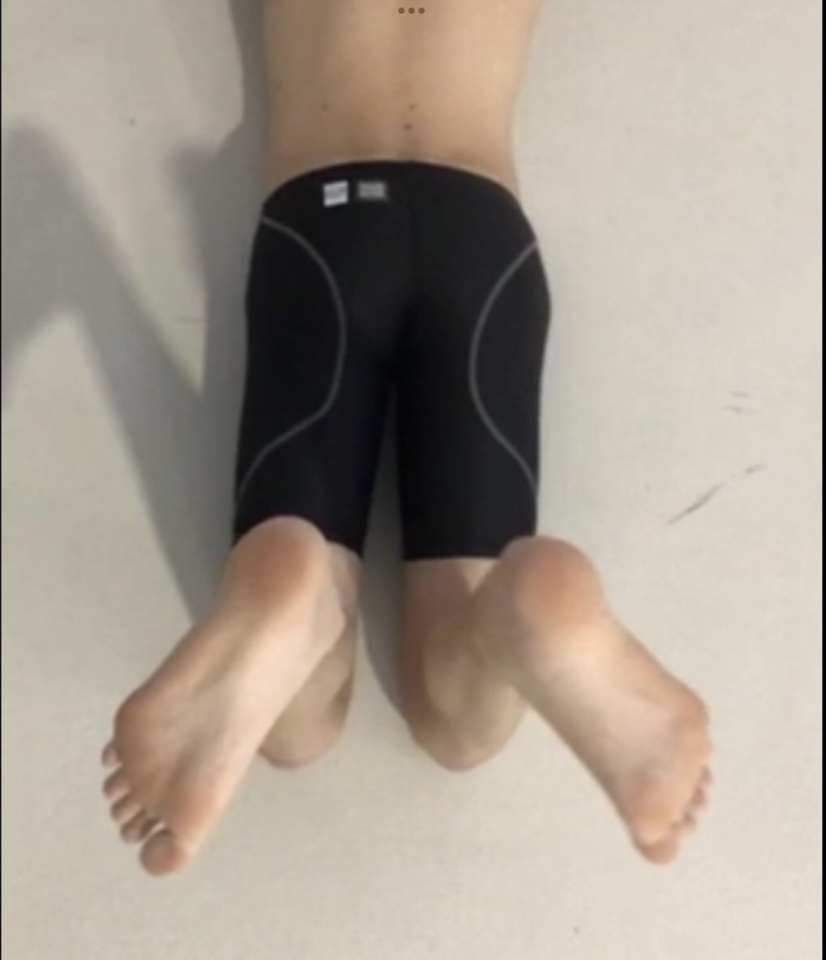
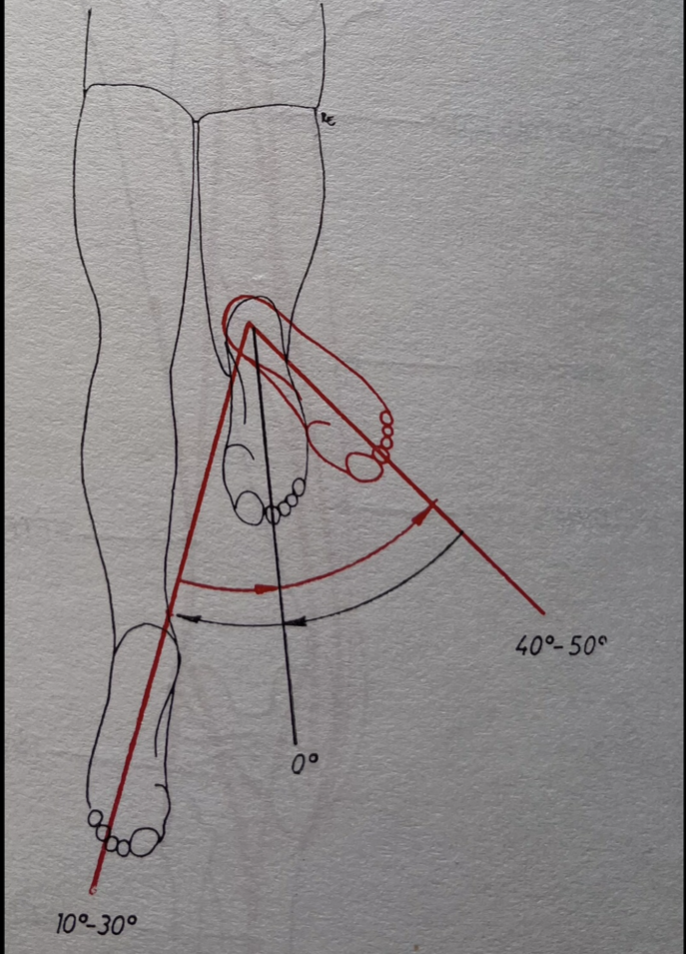
The foot can rotate outward by approximately 45 degrees. If the knees are kept close together, it is simply impossible to rotate the feet to 90 degrees relative to the direction of movement and the backward kick. This is exactly where the narrow-knee breaststroke kick theory collapses. The solution however is simple, because the other 45 degrees can come from the hips.
As shown in the third and fourth pictures the hip is also capable of rotating outward by approximately 45 degrees.
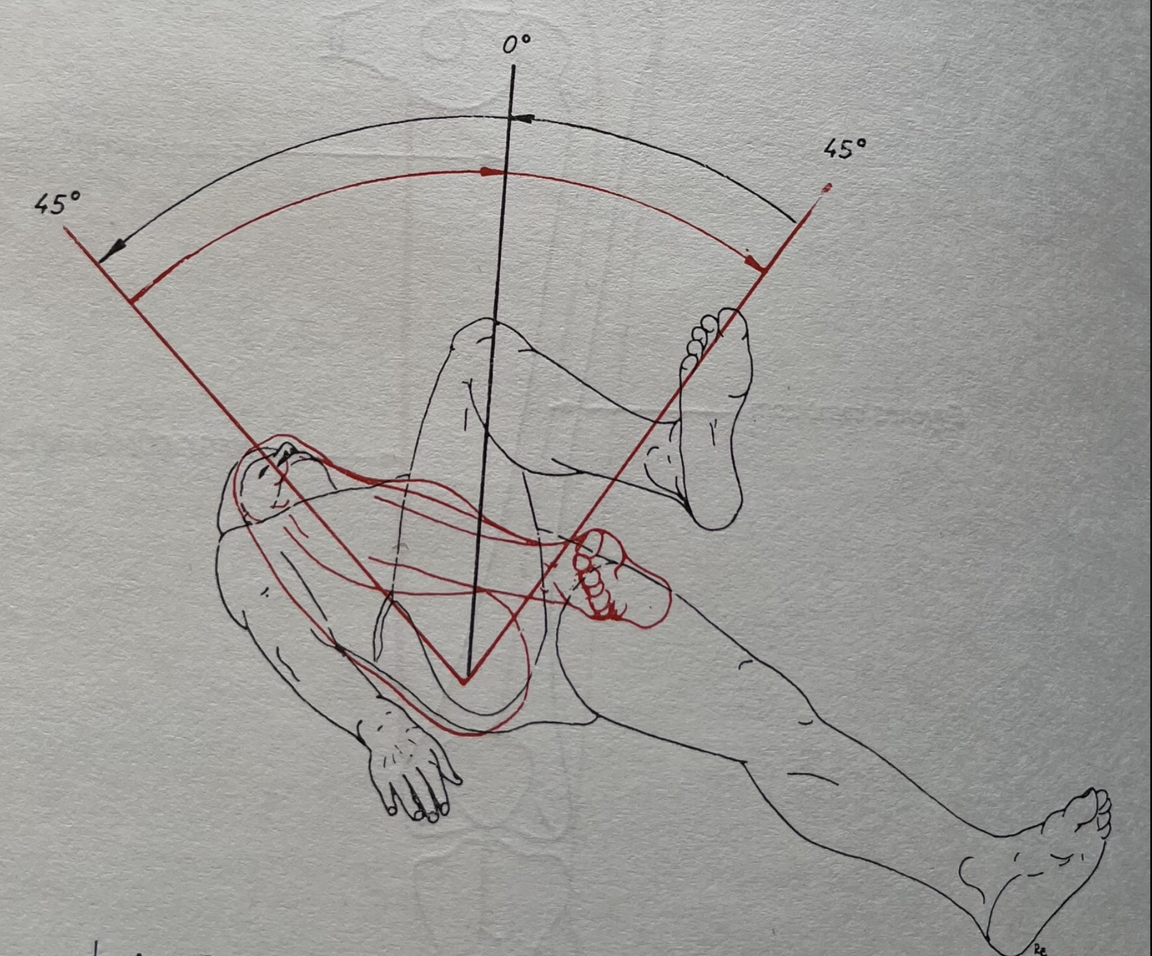
And with this, we arrive at the solution. Of course, no two people — or swimmers — are identical, so these numbers can vary depending on individual anatomy and the swimmer’s flexibility.
Still, most coaches defend the idea of keeping the knees as narrow as possible during the breaststroke kick because they fear that wider knees create more drag. This is not the case. This idea is an illogical concept that demonstrates a lack of anatomical understanding.
Our femur is connected to the hip joint as a ball-and-socket joint. It functions much like the tip of a cone, meaning the thigh can move along the surface of a cone. As we know, the resistance of a cone is determined by the cone’s angle, not by any specific point on its surface. This is why it is extremely important that breaststroke swimmers pull their knees and thighs upward as little as possible during the kick recovery phase, because this creates the greatest resistance during the stroke cycle.
At the same time, the knees should open wide enough to allow the feet to rotate outward perfectly, as shown in the fourth picture.
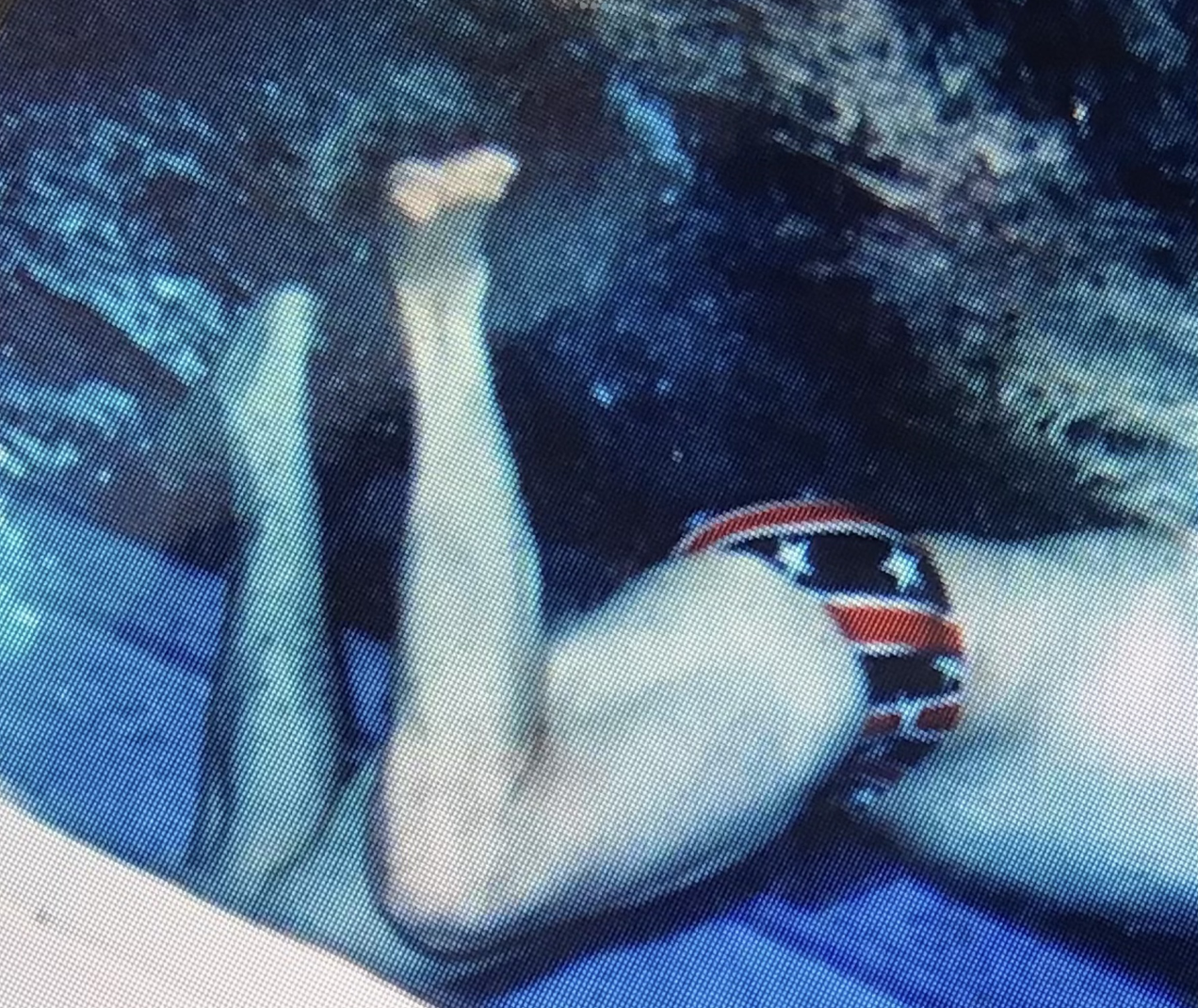
I hope the previous paragraphs and the images were convincing.
Pictures #2 and #3 courtesy of Dr Marta Miltenyi’s “The anatomical foundations of sports movements.”
Get More SwimSwam with SwimSwam Magazine

SwimSwam Magazines are big, coming in at nearly a pound per issue. We provide you four massive print issues designed to sit on your coffee table like a piece of artwork. With your yearly subscription, you receive over 600 of pages of swimming’s highest quality print content, and another 5,330+ pages of digital issues, going back to the first issue produced.

Content aside the pics in this article are crazy no shade
Does somebody know what he’s working for the Hungarian Swimming Federation?
Because we not.
Reject humanity, return to frog
Look at Kate Douglas, legs wider that what we called for 25 years ago. Same for Adam and Van. hat still is the same is the heels must explode up to the buttocks with the least angle from horizontal. ASCA Level 5 Coach
Did you think Peaty had a wide kick? To me it looked pretty narrow.
He definitely has a wide pull
I don’t teach a narrow kick but I see the benefit of working on it because a common issue you see at the age group level is knees wider than feet (like knees go out heels stay close).
This is the only kick pattern I will try to change or teach narrower because it is one of the few variations where you don’t see anyone kicking that way at the highest level.
Has he seen van mathias’ kick?
And shin ohashi
I could go on about this all day but hip mobility/flexibility is crucial for power. Reducing drag has less to do with knee width, and more to do with timing and bringing heels up in line with the upper leg. Knees should typically stay in a comfortable line with the hips and if they go wide it is usually overcompensation for poor hip mobility. Knees close together isn’t necessary but looks neat when super flexible people are showing off.
I’m one of the uninformed. So glad I read this article.